


Phonemic awareness helps little listeners tune into the smallest sounds in words, laying the foundation for learning to read and spell.
Learning to read starts with listening to language. As your child’s language skills grow, they’ll start noticing patterns in spoken words. For example, your child might recognize that the words in Peter Piper picked a peck of pickled peppers all start with the same /p/ sound. That means your child is developing phonemic awareness. What is phonemic awareness? It’s the ability to recognize and work with the individual sounds—called phonemes—in spoken words. It is an essential skill for reading development according to the science of reading.
Phonemic awareness is part of a broader skill set called phonological awareness. This involves recognizing and manipulating the sound structures of spoken language. Recognizing rhyming words or clapping for each syllable in a word (as demonstrated in this syllable video) are examples of phonological awareness skills. As these skills develop, children learn to work with the smallest sounds within words—phonemes—and develop phonemic awareness.
While there are 26 letters of the alphabet in the English language, there are 44 phonemes. What are phonemes? A phoneme is the smallest unit of sound within a word that can change its meaning. For example, if the middle sound in the word cat is changed from the short a sound to the short o sound, the word becomes cot. The sounds are grouped into categories such as consonants, short vowels, and digraphs. However, children don’t need to know these terms as long as they can distinguish the sounds when they hear the words. For instance, they should be able to hear the /f/ sound at the beginning of fan versus the /v/ sound at the beginning of van.
Some examples of phonemes are:
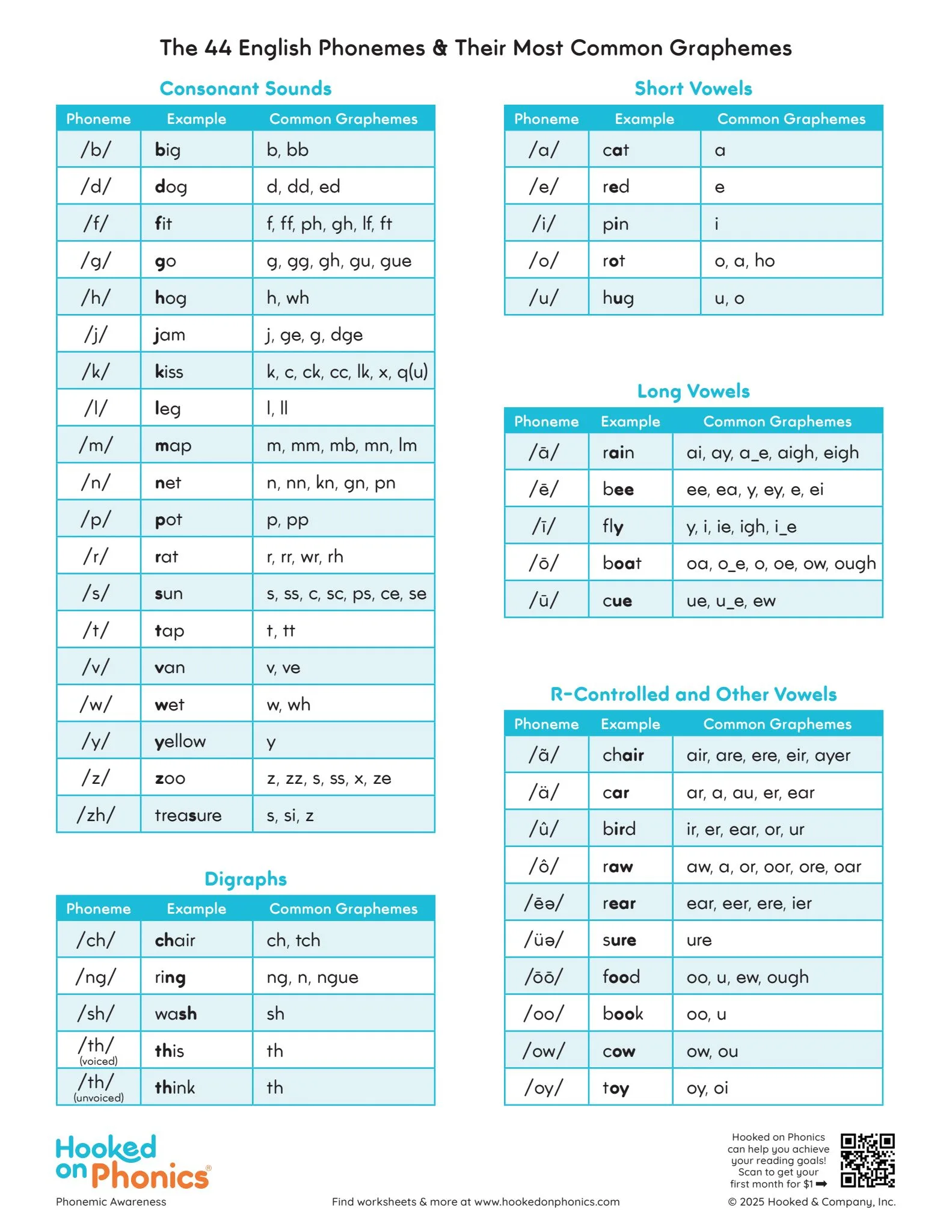
As your child develops phonemic awareness, they will be ready to learn about phonics. Phonemic awareness is developed through listening and speaking. Phonics involves listening, speaking, and looking at written letters and words. When children learn about phonics, they will learn about the letters of the alphabet and the sounds they make. Phonemic awareness skills support phonics skills—and they are best learned together!
Developing the ability to hear, isolate, and manipulate phonemes is foundational to learning how to read. Building strong phonemic awareness skills will strengthen your child’s phonics skills. You can start by teaching your child the alphabet. Solid phonemic awareness skills also improve your child’s spelling skills as well.
To help your child develop phonemic awareness, there are six key skills to focus on: isolation, blending, segmenting, addition, deletion, and substitution. Start by focusing on the simplest skills—isolation, blending, and segmenting.
This involves recognizing and isolating individual sounds in words, such as identifying the first sound in cat (/k/). This skill is the foundation of phonemic awareness and is crucial for helping children understand how sounds work in language. Try some beginning sounds worksheets or play listening games like these.
When asking children to isolate phonemes, have them work with CVC words (consonant/vowel/consonant words.) It’s easiest for children to recognize sounds at the beginning or end of words, so start by asking your child to identify beginning sounds. Next, rhyming words for kids are a fun way to practice ending sounds. Finally, try tackling middle sounds, which are the trickiest to hear.
Combining individual sounds to form a word, such as blending /c/, /a/, and /t/ to say cat. For example:
Start with words that involve two phonemes, like at or in. Then move to CVC words and have your child blend the three phonemes of each word together, working with words such as bit or run.
Breaking a word into its individual sounds, like breaking dog into /d/, /o/, and /g/. Try activities like these:
Our App games make it FUN to learn the alphabet — see for yourself!

Slide the pictures with the correct letter sound into the silly spider’s web!

Unlock a letter’s sound by moving the picture to the correct door.

Decorate the lake by dragging the correct flower onto the lily pad.

Deliver the ant’s package by tapping the scooter with the right letter sound.

Tap on the correct capital letter to help the busy bee get back to its home hive.

Balance alphabet learning and letter sounds in this sweet seesaw game.
Once your child is comfortable with isolation, blending, and segmenting, you can introduce them to manipulating phonemes in words. It’s important to note that these skills will develop alongside phonics instruction as your child is beginning to read.
Adding a sound to a word to make a new word, such as adding /s/ to top to make stop. Play games like:
Before doing these activities, identify the words and sounds that you will give your child. Not all words can have another phoneme added to them to make another word, so be mindful of the particular words you choose.
Taking sounds away from words to make a new word, like taking away the /s/ sound from smile to get the word mile. Try some word games:
Begin by having your child take away the initial or ending sounds. As they develop their skills, you can have them delete phonemes in the middle of the words, such as removing /l/ from the word play to make pay.
Changing one sound in a word to another to say new words, for example, changing the /h/ in hat to /p/ to make pat.
Begin by having children substitute phonemes at the beginning of CVC words. After your child has mastered this, you can move on to substituting phonemes at the end or in the middle of words and/or to more complex words than CVC words.
Helping your child to build their phonemic awareness skills helps to give them strong foundations for reading and writing. Plus, it can be fun! Build in time to talk about sounds in words and do phonemic awareness activities. Supporting your child’s skill development—and showing that you genuinely care about their learning—will set them up for future success.


Reading is an essential skill that lets us unlock meaning from written words.
Understanding the meaning what is written on the page is the goal of every reader.
Phonics teaches children how letters in print represent individual sounds in spoken language.
The ability to understand and use a variety of words is one of the keys to reading success.
Phonics skills can also help readers translate speech to print.
Good readers are fluent readers, because they can read quickly, accurately, and sound as if they were speaking aloud instead of reading.
Receive materials to enhance your child’s learning journey.
Access our library of free printables and more.
Boost confidence and foster a lifelong love of learning.
By signing up for our newsletter you agree to our Privacy Policy and Terms of Use.
Over 6 million learners and counting!
Get Started Today


By signing up for our newsletter you agree to our Privacy Policy and Terms of Use.


