Phonological awareness is the ability to identify and manipulate sounds in spoken language, without focusing on written letters. Unlike phonics, which connects sounds to written letters, phonological awareness focuses purely on sounds. It’s an auditory, or listening, skill that helps children break words into their component sounds, blend them together, and play with them in meaningful ways.
Supporting Reading and Spelling
How does listening to language help with reading and writing? Phonological awareness skills help kids understand that sentences are made of words, and words are made up of even smaller sound units, such as syllables. Recognizing basic word sounds helps kids understand language structure and is essential for decoding words on a page.
Research has consistently shown that phonological awareness is one of the best predictors of later reading success. Studies show that “Students who have difficulty reading have poorer phonological awareness compared to students who have no difficulty reading.” ¹ Children who develop strong phonological skills in preschool and early elementary school tend to become confident readers. When kids can hear, identify, and manipulate sounds in spoken language, they find it easier to match those sounds to letters when learning to read.
Phonological Awareness Skills
It’s important to note that phonological awareness is an umbrella term that covers different skills that form the foundation of understanding language. Children develop these skills over time. Phonological awareness skills begin developing in infancy as babies become attuned to the rhythm and melody of spoken language. These skills continue to grow through toddlerhood and preschool, becoming more refined in early elementary school. By second grade, most children have mastered these skills and use them automatically in reading and spelling. For some children, these skills will come naturally through conversation or from hearing books read aloud. But for others, activities that explicitly target these skills are essential for learning to read.
Here’s an overview of the main skills, when they typically develop, and activities parents can do to support them. It’s important to remember that these are listening skills—phonological awareness activities can often be done with your eyes closed.
Word Level Awareness (Ages 3-5)
Understanding that sentences are made up of individual words (sentence segmentation) as well as recognizing words with the same ending sounds (rhyme) or beginning sounds (alliteration) forms the root of phonological awareness. Playing games that involve rhyme, alliteration, and sentence segmentation helps kids develop an understanding of sound structure in spoken language.
Rhyme
Recognizing and generating rhymes helps children understand sound patterns in words.
Rhyming skills develop in phases. A child is first exposed to rhyme through stories, music, and games. Next, they begin to recognize rhymes, and finally, they start to produce rhymes on their own. Identifying rhyming words and generating new, real or nonsense, words is a phonological awareness skill that supports the understanding of word structure. Typically, for single-syllable words, this will be the vowel sound and the final sound. For example, knowing that the words bat and mat rhyme with each other but set does not.
- Rhyming Train: Say a word and having your child come up with words that rhyme (real or nonsense words). For example, “cat—bat, sat, mat, splat!”
- Finish the Rhyme: When reading a familiar rhyming book aloud, read a sentence and let your child complete the next sentence with the rhyming word.
- Picture Sorting: Sort a series of picture cards based on rhyme or try a rhyming worksheet.

Alliteration
Recognizing the same beginning sounds in a series of words strengthens phonemic awareness.
Alliteration (uh-lit-er-ay-shun) means hearing the same sound at the beginning of most of the words in a sentence. Tongue twisters are a common example of alliteration. Sally sells seashells and Peter Piper picked a peck of pickled peppers are both examples of alliteration. Activities with alliteration help children notice repetition, priming their sound isolation skills.
- Name Game: Make up silly alliterative phrases or tongue twisters using names-especially if it’s your child’s name!
- Sound Hunt: Give a sound and look for objects in the room that start with that sound.
- Read a classic tongue-twisters to your child. Can they repeat what you read?

Sentence Segmentation
Understanding that sentences are made up of separate words lays the groundwork for later word segmentation.
Sentence segmentation helps kids identify that there are individual words in a sentence. For example, how many words are in the sentence Did you find my toy? Can you count those words out if you hear the sentence instead of reading it?
- One to One: Clap, jump, or stomp for each word heard in a given sentence. Start with sentences using one-syllable words. Gradually introduce two-syllable words to help your child understand the difference between words and syllables.
- This adorable free video will teach your little learner how to tap along to words in a sentence.

Syllable Segmentation and Blending (Ages 4-6)
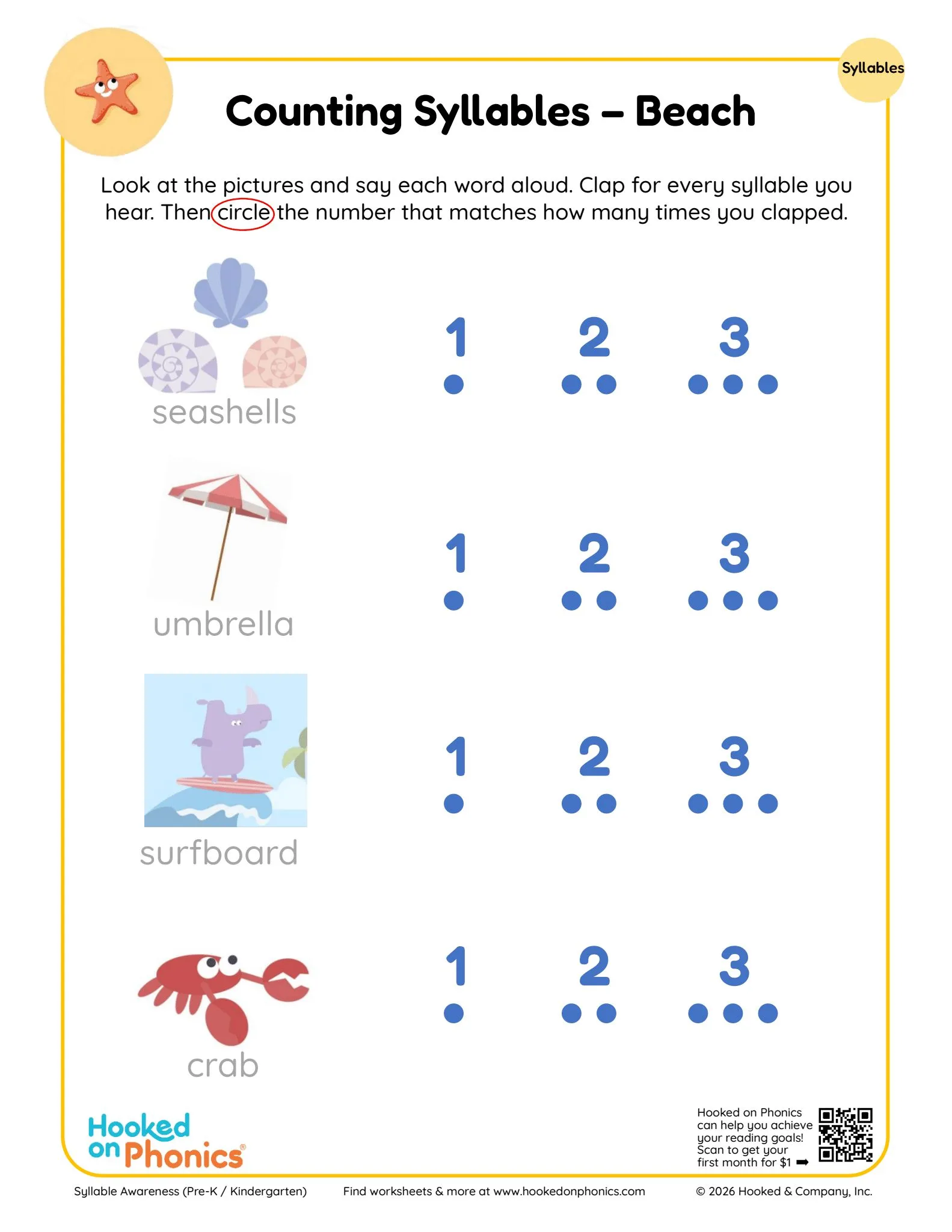
Words can be broken down into syllables, which are single units of sound within a word. Breaking words into syllables helps children hear the rhythmic units in words. For example, you clap once for the one-syllable word “cup,” twice for the two-syllable word “cookie,” and three times for the three-syllable word “microwave.” The ability to break a word into its syllables is called syllable segmentation. This couples with syllable blending, which is the skill of combining isolated syllables to form a whole word. These skills help emerging readers understand that words are made up of parts. Knowing how to break apart and read each segment is essential for reading and writing longer words in context.
- Clap it Out: Say a word and kids can clap, stomp, or tap for each syllable. For example, cook-ie, mi-cro-wave, or syl-la-ble.
- What’s My Word: Say a word slowly by stretching out the sounds (e.g., /rab/-/bit/) and let children blend the syllables together to say the word aloud. This can be made more interactive by involving a puppet talking in “slow motion.”
Onset and Rime (Ages 4-6)
Understanding that words have an onset (beginning sound) and rime (ending sound) supports early decoding skills. This makes it easier and faster to read new words. Onset is the first sound or sound cluster—everything that comes before the vowel. Rime (not rhyme) is the vowel and everything after it. For example, in the word bag, /b/ is the onset and /-ag/ is the rime. In the word spring, /spr-/ is the onset and /-ing/ is the rime. Remember: we’re talking about sounds here, not letters!
Onset and rime activities bridge the gap between phonological awareness and phonics, strengthening the ability to manipulate sounds in words and blend and segment sounds effectively, building a base for decoding.
- What’s My Word: The same activity that’s used for syllable blending can be used for onset and rime. This time, say the onset and rime separately so children can blend the sounds together.
- Build-a-Word: Write onsets (i.e. b, c, h) and rimes (i.e. –at, –op, –ig) on individual index cards. Kids will build words with an onset and rime and say the words they form.
Phonemic Awareness (Ages 4-8)
Phonemic awareness is the ability to recognize and work with the individual sounds—called phonemes—in spoken words. It is the most complex skill of phonological awareness, and on its own, is considered one of the pillars of learning to read. Often, these skills will develop at the same time a child is learning to recognize letters and connect them to their sounds.
Kids will often begin developing these skills by recognizing the first sound in a word, for example that bat begins with the sound /b/. If kids are using a phonics-based program to learn to read and spell, they will practice blending and segmenting phonemes, or sounds, in words. As their reading skills develop, they will be able to add, delete, or substitute phonemes from the beginning or end of the words.
Phonemic Awareness Skills
Isolating (Ages 4-6): Recognizing individual sounds in a word is a key step toward reading
Ask your child to identify the first sound in a word (e.g., “What sound do you hear at the beginning of ‘sun’?” – /s/). For a challenge, try ending and middle sounds
Blending (Ages 4-7) Blending is the ability to put sounds together to form words. It progresses from blending larger units to smaller ones.
Say sounds separately and have your child blend them together to make a word. To start, have your child blend two parts of a compound word (butter, fly), then progress to syllables (but-ter-fly), finally blend individual phonemes.
Segmenting (Ages 5-7) Segmenting is breaking words apart into their individual sounds
Say a word and have your child break it into its sounds. For example, “dog” = /d/ /o/ /g/. Again, you may start with segmenting a compound word into its parts, progress to syllables, then move on to phonemes.
Adding (Ages 5-7) Adding phonemes to words helps children manipulate sounds
Play “grow a word.” Start by saying “at” and ask your child to add a sound to make a new word. They may say ats or cat. Then you take a turn adding another sound: stats. See how many sounds you can add to make your word grow, nonsense words welcome!
Deleting (Ages 5-7) Removing sounds from words strengthens phonemic manipulation skills
Ask, “What’s ‘bat’ without the /b/?” (“at”). Make this even sillier by trying to say a sentence deleting the first sound of every word. “What do you want for dinner” becomes “at o ou ant or inner?”
Substituting (Ages 5-8) Swapping one sound for another
Take turns substituting sounds in words and see how long you can go. You might start with cat, then your child says cut, then you say cot, then pot. Start with beginning sounds only, then include beginning, middle, and ending sounds.
Having Fun with Phonological Awareness
We know that phonological awareness is critical for early reading and writing development. But while the skills are serious, the learning environment doesn’t have to be! Help your child see that playing with language is fun! Little ones will take more from games and activities when they are more engaging and the more you demonstrate your enthusiasm.
Have some fun with phonological awareness at home. After all, establishing phonological awareness from an early age is a strong indicator for reading success!